AI Skills: How Small Businesses Can Automate Expertise Without Hiring
Discover how AI skills transform Claude from a general assistant into a specialist that knows your business. Real examples for service businesses ready to work smarter.
Paul Saunders
Founder, Smash It Marketing

AI Skills: How Small Businesses Can Automate Expertise Without Hiring
You've probably used ChatGPT or Claude to draft an email or answer a quick question. But here's what most business owners don't realise: AI can do far more than answer questions. It can become a specialist that understands your specific business, follows your exact processes, and produces work that matches your standards - every single time.
The technology that makes this possible is called AI Skills. And for small to medium businesses, skills represent something genuinely transformative: the ability to package your expertise into reusable AI capabilities that work while you focus on growing your business.
What Are AI Skills?
Think of AI skills as instruction manuals that teach AI exactly how you want things done.
When you ask ChatGPT to write a proposal, it gives you a generic response. It doesn't know your pricing structure, your tone of voice, or that you always include a 14-day payment term. You end up editing heavily or starting from scratch.
AI skills change this completely. A skill is a set of instructions, examples, and resources that transform a general-purpose AI into a specialist for specific tasks. Once created, the AI follows your process consistently - whether you're using it at 9am on Monday or 11pm on Sunday.
Here's what makes skills different from just "prompting" an AI:
- Persistent knowledge - The AI remembers your processes across every conversation
- Consistent output - Every proposal, email, or report follows your format
- Reduced effort - No more explaining the same context repeatedly
- Scalable expertise - Your best practices become available to your whole team
Real Examples: Skills in Action for Service Businesses

How I Use Skills at Smash It Marketing
I'll be honest: skills have transformed how I run my own business. Here's what I've built:
Development Skills - When I'm building client dashboards or web applications, I have skills that know our coding standards, preferred frameworks, and how we structure projects. Instead of remembering to add proper error handling or follow our naming conventions, the skill ensures consistency across every project.
SEO Content Skill - This skill knows our SEO best practices, keyword density guidelines, heading hierarchy rules, and even prompts me to add internal links. When I write blog posts (like this one), the skill ensures everything is optimised before I publish.
Client Communication Skill - Handles proposal templates, project update formats, and even how we structure meeting notes. Every client gets the same professional experience.
The real power? These skills reference each other. My content creation skill automatically triggers the SEO skill. My project setup skill references the coding standards skill. It's like having a team that's always on the same page - because the "team" is a coordinated set of skills working together.
The Dental Practice Reception Skill
A Perth dental practice created a skill for handling patient enquiries. The skill knows:
- Their available appointment types and durations
- The dentists' specialisations (Dr Smith does implants, Dr Jones handles paediatric cases)
- Standard responses for common questions about costs, payment plans, and health fund claims
- The practice's friendly-but-professional tone
Now when their receptionist needs to respond to email enquiries, they simply paste the enquiry into Claude with their skill active. The AI drafts a response that sounds like it came from someone who's worked at the practice for years - because the skill contains years of accumulated knowledge.
The Tradesperson Quote System
An electrical contractor built a skill for generating job quotes. The skill includes:
- Standard hourly rates for different work types
- Material markup calculations
- Compliance disclaimers required for electrical work in WA
- A professional template matching their branding
What previously took 20 minutes of looking up rates, calculating margins, and formatting now takes 90 seconds. The tradesperson describes the job, and the AI produces a quote ready for review and sending.
The Accountant's Client Onboarding
A small accounting firm uses a skill for new client intake. The skill:
- Generates personalised welcome emails based on service type
- Creates a checklist of documents needed for tax returns
- Drafts engagement letters with appropriate terms
- Schedules follow-up reminders in their preferred format
One skill replaced what used to require an admin assistant to handle. The accountant reviews and sends - the creation happens automatically.
Could Skills Work for Your Business?
Before diving into implementation, it's worth asking yourself some questions. Skills work best when you have:
Repetitive tasks that follow patterns
- Do you write similar emails, proposals, or reports regularly?
- Are there processes you've explained to employees multiple times?
- Do you have templates you keep modifying for different clients?
Expertise worth capturing
- Have you developed specific ways of handling situations over the years?
- Do new team members take months to learn "how we do things here"?
- Would your business lose valuable knowledge if a key person left?
Time-consuming manual work
- Are you or your staff spending hours on tasks that feel mechanical?
- Do you delay important work because admin tasks pile up?
- Could you serve more clients if you weren't bogged down in paperwork?
If you answered yes to several of these, skills could genuinely transform how you operate.
"But Aren't Skills Just Digital SOPs?"
I can hear you thinking it: "Paul, this sounds like standard operating procedures with extra steps. We already have documented processes - why do we need AI skills?"
Fair question. Here's the difference:
SOPs tell humans what to do. Someone still has to read the document, interpret it, and execute each step manually. They might skip steps, get distracted, or interpret things differently depending on their mood or workload.
Skills tell AI what to do - and the AI executes it. The skill doesn't just document your process; it performs the process. Every time. Without variation, without fatigue, without forgetting step 4 because they were rushing before a meeting.
Think of it this way: an SOP for writing client proposals might say "Include our standard payment terms and adjust pricing based on project complexity." A skill actually pulls the payment terms, calculates the pricing, and assembles the proposal. You review and send - the creation happens automatically.
SOPs are instructions for people. Skills are instructions that work.
How Skills Actually Work (The Technical Bit)
You don't need to be technical to use skills, but understanding the basics helps you see the possibilities.
Skills are stored as text files - essentially detailed instructions written in plain English. When you invoke a skill, the AI reads these instructions and follows them precisely. A skill typically includes:
A description - When this skill should be used. "Use this skill when creating client proposals for web design projects."
Instructions - Step-by-step guidance. "First, ask about the client's industry and goals. Then outline our three service tiers..."
Examples - Samples of good output. "Here's a proposal we sent to a similar client that won the work..."
Resources - Reference materials. "Our current pricing is in the attached rate card. Our standard terms are in terms.pdf..."
The AI combines all of this context when generating output. It's not guessing or making things up - it's following your documented process.
The Skill Hierarchy
Skills can be organised at different levels:
- Personal skills - Just for you, stored in your settings
- Project skills - Shared across a specific project or client
- Team skills - Available to everyone in your organisation
This means you can have a personal skill for your writing style, a project skill for a specific client's requirements, and a team skill for company-wide processes. They all work together.
Skill Stacking: The Real Magic
Here's where it gets genuinely powerful: skills can reference and trigger other skills.
Imagine you're creating a client proposal. Your proposal skill knows to:
- Pull your standard pricing from the pricing skill
- Apply your brand voice using the writing style skill
- Include compliance disclaimers from the legal skill
- Format everything using the document template skill
You don't think about any of this. You just say "create a proposal for this project" and the skills coordinate automatically. It's like having multiple specialists who already know how to work together.
This is what I mean by AI that "thinks for you." The orchestration happens behind the scenes. You focus on the actual decision-making - does this proposal look right? Is the price competitive? - while the skills handle the mechanical assembly.
For my own work, I've built skill chains for:
- Blog posts: Content creation → SEO optimisation → internal linking → image suggestions
- Client projects: Project setup → coding standards → documentation → deployment checklist
- Proposals: Pricing calculation → template formatting → terms inclusion → review prompts
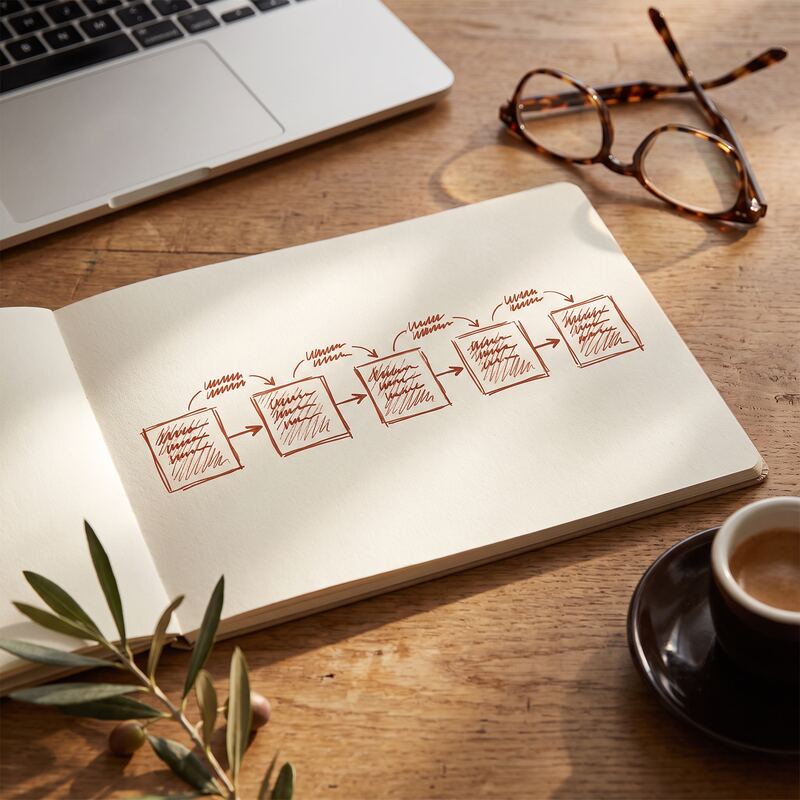
Each step triggers the next automatically. The AI knows the workflow because I've encoded it once.
Five Skills Every Service Business Should Consider
1. Client Communication Skill
Handles email drafting, follow-up messages, and standard enquiry responses. Include your tone of voice, common questions and answers, and any phrases you always use.2. Proposal/Quote Generation Skill
Takes basic job information and produces formatted proposals. Include your pricing logic, standard inclusions, terms and conditions, and professional formatting.3. Meeting Notes and Follow-Up Skill
Transforms rough meeting notes into professional summaries and action items. Include your preferred format, how you assign tasks, and standard follow-up templates.4. Content Creation Skill
Produces blog posts, social media updates, and marketing materials in your voice. Include your writing style guide, topics you cover, and examples of content you're proud of.5. Onboarding and Documentation Skill
Creates welcome materials, process documentation, and training guides. Include your standards, common procedures, and preferred formats.Getting Started: Your First Skill
You don't need to build all five skills at once. Start with one that would make an immediate difference.
Step 1: Choose your highest-repetition task What do you do repeatedly that follows a similar pattern? Start there.
Step 2: Document your current process Write down exactly how you do this task. Include examples of good output.
Step 3: Note the variations What changes between instances? Client name, project details, pricing? These become the inputs.
Step 4: Create the skill Write instructions the AI can follow. Be specific about format, tone, and required elements.
Step 5: Test and refine Try the skill on real work. Note where the output needs adjustment and update the skill.
Most businesses can create their first functional skill in an afternoon. Perfecting it takes a few iterations, but even version one typically saves significant time.
The Bigger Picture: Skills as Business Assets
Here's what excites me most about AI skills for small businesses: they become assets that appreciate over time.
Every improvement you make to a skill benefits all future work. Your best practices become encoded and repeatable. New team members can access years of accumulated expertise from day one.
Consider this: if you spend 10 hours creating and refining a proposal skill that saves 30 minutes per proposal, and you write 50 proposals per year, you've saved 25 hours in year one alone. By year three, you're ahead by 65 hours - and the skill keeps improving.
This is what I mean when I talk about working smarter, not harder. AI skills let you package your expertise once and deploy it infinitely.
What's Next?
AI skills represent a genuine shift in how small businesses can operate. You don't need to hire more staff to handle increased volume. You don't need to sacrifice quality for speed. You can have both - if you invest the time to build the systems.
If you're curious about how skills could work for your specific business, I'm happy to have a conversation. We help Perth businesses identify their highest-impact automation opportunities and build the skills that deliver real results.
The question isn't whether AI will change how service businesses operate. The question is whether you'll be ahead of that curve or playing catch-up.
Take the Next Step
Ready to explore what AI skills could do for your business?
Book a free AI Strategy Call and we'll identify your three highest-impact automation opportunities - no technical knowledge required.
Related Reading
- How AI SEO Made Our Business Discoverable to ChatGPT - Make your business visible to AI assistants
- AI Solutions for Business - Our full range of AI automation services
- Content Creation Services - Build authority content that works while you sleep
Paul Saunders
Founder of Smash It Marketing — a boutique, AI-first agency pairing 18 years of Google Ads with an AI-first service suite. Book a call.